
2026 Midterm Voter Registration Is Up for 18-Year-Olds
Whether we can increase these numbers further depends on whether we take action to help teens understand the importance of democracy, the right to vote, and the value of organizing among their peers.
This week I have great news: Our new research shows that many more 18-year-old Americans are registered to vote in this year’s midterm elections than at this point in 2022. Many states have seen a significant increase in youth registration since the last midterm year: Minnesota leads the pack with a massive 58-point increase in its rate since 2022. The bad news, however, is that nationwide, 18-year-old registered voters still trail the over-45s by 40 points, which remains a huge and unacceptable but fixable gap.
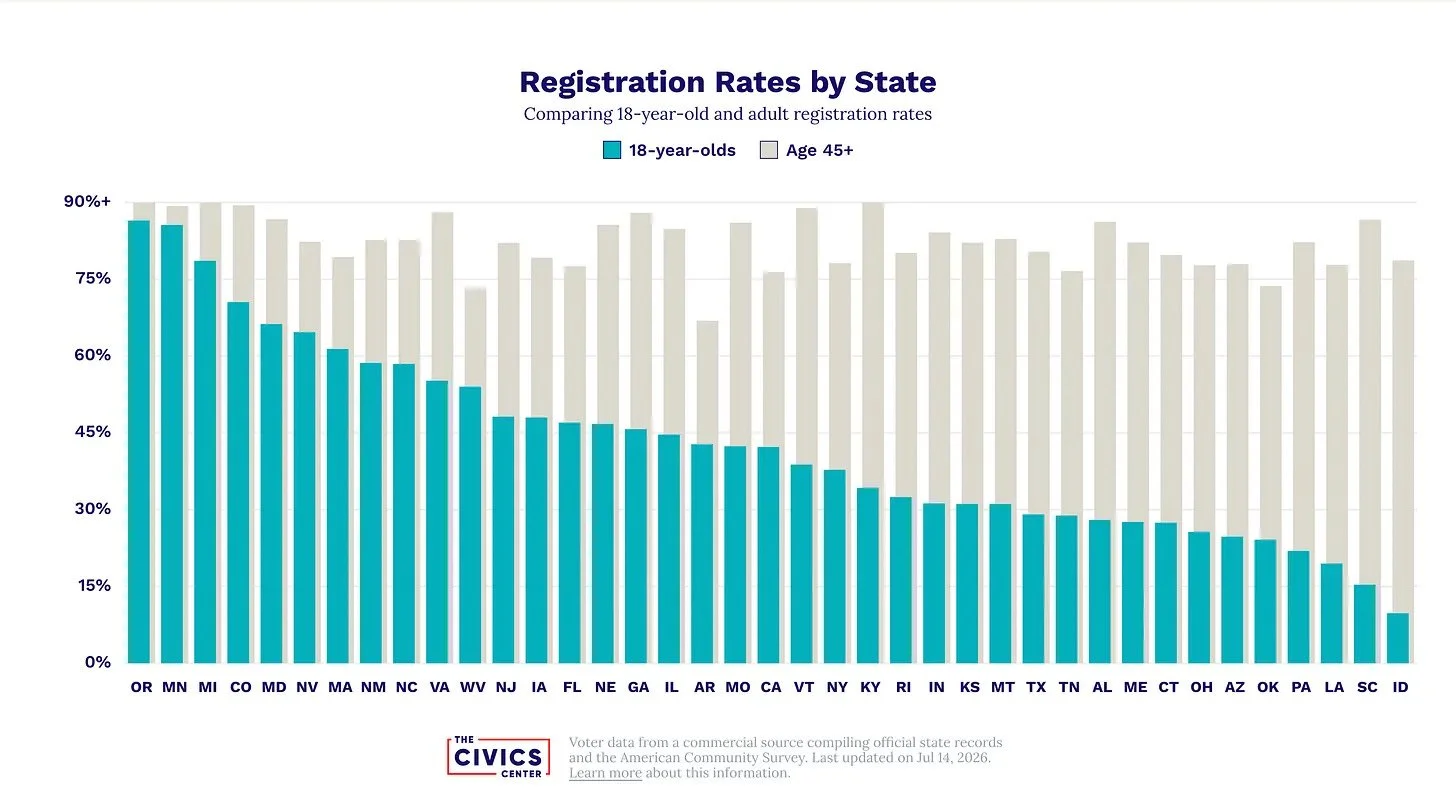
Our new estimate is based on data from voter files as of Spring 2026 across 39 states, showing 42% registration for 18-year-olds; in contrast, 82% of 45- to 79-year-olds are registered. Only 35% of 18-year-olds were registered at approximately the same point in 2022, according to the voter files. By election day in 2022, that number had risen by 9 points to 44%, suggesting there is still room for today’s rates to rise significantly by November.
A similar increase this year would bring our estimated rate of registered 18-year-olds nationwide to 51% and add more than 350,000 18-year-olds to the voter files.
Twenty-one states have raised their 18-year-old registration rates by more than 5 percentage points since the summer of 2022; five have managed dramatic increases of more than 20 points, led by Minnesota with a 58-point gain. The other four big gainers are Illinois, Michigan, New Mexico and Virginia. The remaining 16 states that have seen a 5+-point rise are Colorado, Connecticut, Florida, Georgia, Louisiana, Maine, Maryland, Massachusetts, Montana, Nebraska, Nevada, Oklahoma, Oregon, New York, Pennsylvania and Vermont. Another nine states saw rates improve by 2 to 4.9 points.
Erosion is possible, just as much as improvement. While most states are moving to help teens register to vote, we’ve also seen a few retreat. Texas has seen a shocking decline of 13 points since the summer of 2022, potentially stemming from administrative challenges in the state that have resulted in serious delays in the processing of voter registration forms. Idaho and Rhode Island are also down more than 2 percentage points.
The significance and the speed of these changes, and the variations among states, show that low youth turnout is not because teens don’t care. It is a matter of the systems and traditions, communications channels, education, and platforms that reach and engage them – or do not. These results show that large changes in youth political participation are in fact possible, when we design and implement systems better.
With the midterms on the horizon, we have an immediate possibility to significantly raise the registration rate for 18-year-olds but we need to act before we hit state registration deadlines, which begin in early October, weeks before Election Day.
The data shows what’s possible: in 2022, 30 states showed a greater than 5-percentage point increase between summer and Election Day, with Maine, Michigan, Kansas, and Georgia each showing gains of more than 15 percentage points. In general, the states with the greatest gains during this period were those with highly competitive races for statewide office or ballot measures such as those concerning abortion rights.
We know that new registrations for the youngest voters increase dramatically in the run-up to elections - our week-by-week chart of registration rates in New York illustrates the trend:
This year, we’re on track for the highest 18-year-old voter registration rate in any midterm election we have tracked to date. The enormous changes we have seen since 2022 are likely due to many factors, including:
suppressed/lower registration in 2022 due to the pandemic
enormous gains in states that improved their registration systems
greater awareness of preregistration and organizing voter drives in high schools
On the other hand, voter suppression efforts, like the passage of state versions of the SAVE Act, have likely led to lower rates or prevented even bigger increases.
Whether we can increase these numbers further depends on whether we take action today to help young people understand the importance of democracy, the right to vote, and the value of organizing among their peers.
Free and fair elections mean elections that are free and fair for everyone, and that requires high turnout – which starts with registration.
Here’s what you can do to help:
Encourage teens to register, to get ready to vote, and to run a drive in their schools. Our interactive map starts the process to get them what they need.
Share our resources with educators who can work with teens to make voter registration part of high school life. We have toolkits, lesson plans, data, and reliable election information.
Donate and encourage your network to donate so that we can raise awareness and provide support to students and educators who want to make a difference by leading voter registration drives in high schools this fall, a critical time.
Background on how we calculate these estimates
For the 39 states captured here, we use data from a commercial vendor derived from official voter files, as well as data from the American Community Survey (ACS).
We do not have registration information from which we can estimate registration rates for 18-year-olds for the following states: Washington, Alaska, Hawaii, Utah, Wyoming, South Dakota, Wisconsin, Mississippi or Delaware. New Hampshire is also excluded here due to lack of current information. Our most recent report on New Hampshire is here. Based on the relatively low combined population of these omitted states, which together accounts for roughly 10 percent of all registered voters in the US, we do not expect that additional information from these states would substantially change our estimates. North Dakota does not require voter registration.
Our methodology for estimating registration rates for 18-year-olds is here.
Prior national estimates we provided relied on Census and ACS data, which showed that historically, under 30% of 18-year-olds were registered to vote, compared to roughly 75% of the over-45s.
Now that we have access to the voter file data, we have increased our estimates to 42% for 18-year-olds and 82% for the 45+ group. We believe these rates are more reliable than Census and ACS data alone, which are based on self-reporting rather than official registration records in the voter files. While Census and ACS data suggested a 45-point gap between registration rates for 18-year-olds and older voters, voter files point to a slightly smaller, but still enormous registration gap – 40 percentage points. That gap translates to 1.6 million 18-year-olds missing from voter files just to achieve parity. And if all 18-year-olds were registered, we would have more than 2.5 million added to the voter rolls.
Election Day is less than 3 months away, and voter registration deadlines start hitting in less than 2 months.