
As Driving Declines, So Does Democracy
One of the most significant efforts to expand voter registration in the US has been that in most places, when you get a driver’s license, you can register to vote. That’s good news for drivers, but the dominance of state DMVs as the location of voter registration activities leaves out non-drivers, and the lack of robust alternatives is disenfranchising millions of voters, especially young people. Read our detailed research report here.
Millions of American teens are not driving today: based on data from the Federal Highway Administration and American Community Survey, only 26% of 16-year-olds, 44% of 17-year-olds, and 60% of 18-year-olds hold a license.
All told, more than 7.5 million youth, ages 16-18 do not have a driver’s license. Three million of them will be old enough to vote in 2026, and all of them will be old enough in 2028.
There are many reasons young people are not driving. It’s gotten increasingly expensive and more difficult to get your first permit, there are better transportation alternatives and many young people feel both fear and anxiety about driving.
While this may be good news for the environment, because our registration systems are so tied to the process of getting a driver’s license, it’s bad news for democracy.
Because of our National Voter Registration Act, aka “Motor Voter” law, passed in 1993 (when a higher percentage of young people were driving) state DMVs are the dominant voter registration agencies across the country. And when young people aren’t driving, they also aren’t going to the DMV. So Motor Voter is not working for them.
So where can they get registered to vote? Many people assume that online systems are an easy alternative. But that is not the case. Seven states have no online system at all (including Texas, Montana and New Hampshire). 29 other states have online systems in which the would-be voter can only complete the registration transaction if they have a driver’s license or state ID. So millions of young people are out of luck in registering online.
The result is that on average in midterm elections, under 30% of 18-year-olds are registered to vote, according to US Census data. In contrast roughly 75% of Americans ages 45 and above are registered. That 40 percentage point gap represents one of the most gaping disenfranchisements of any group in the US.
If you combine states with no online registration system and those with an ID requirement, there are 36 states where voter registration is affected by low levels of youth driving. Those states send 72 senators and 331 representatives to Congress. Their state governments are responsible for enacting laws governing the time, place, and manner of elections, including redistricting laws. This is just one example of the potential ripple effects of systems that make it hard for young people to participate. The practical impact of ignoring this issue–the impact on democracy itself and so much more–is enormous.
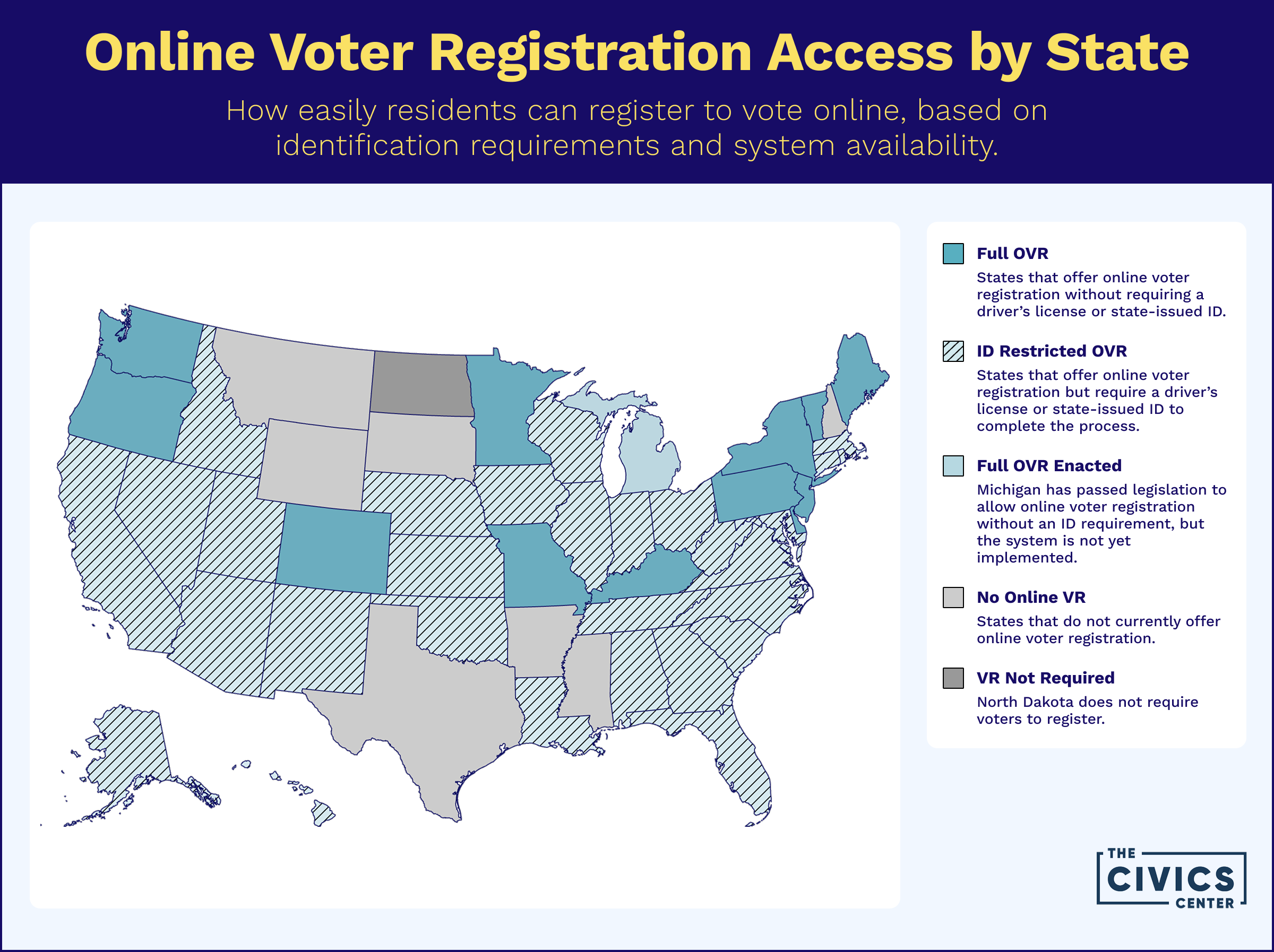
There is an important take-away in this for leaders seeking to build or fund programs to promote youth voter registration and turnout. Social media and other all-digital campaigns to promote voter registration can work well in states that do not require a driver’s license to use an online voter registration system.
But such interventions sadly won’t work for millions of teens: those who live in states without online systems and those who do not have a driver’s license or state ID and who live in a state that requires such ID to use its online system.
It is low-income urban youth who are left out the most because they are the ones who are driving least. For them, catchy claims about the ease of online registration, or the repetition that it only takes 2 minutes, can fall flat because they do not reflect the reality of how their systems work or the challenges young people face.
Driving is getting even more expensive, and youth driving is decreasing because of a movement in states to attach additional requirements for young drivers. Today, all states have Graduated Driver Licensing laws that undoubtedly reduce teen accidents. However, 29 require professional training, which can significantly raise the cost of getting a permit - to around $462 in Ohio, for example. Unsurprisingly, researchers found this impacts low-income youth the hardest. One study showed that teens from wealthy households were 51% more likely to hold a license than their peers in lower-income homes.
There are numerous policy and programmatic interventions that can make a real difference. Many states require high schools to assist with voter registration, and three states have even designated high schools as official voter registration agencies, side-by-side with DMVs. Unfortunately, such laws are often unfunded, unmonitored, and unused. Another intervention is technological, updating online voter registration systems so that users can complete a registration online without a driver’s license or state ID, just as they can in most states with a paper form. Overcoming these policy and technological barriers will take time and resources.
The intervention that does not require new legislation and that is ready for implementation today is found in teens themselves. It means an educational, communications, and leadership development effort to help students understand the importance of registering to vote, the power and impact of voting, and their own capacity to make a difference by registering to vote themselves and helping their peers to overcome the barriers and do the same. That is a culture shift more than a policy or technology shift. It means deciding to do what is possible now, with an understanding that policy and technological solutions will be easier to pass and implement, once there is greater awareness of the need and the people and traditions are in place to implement and sustain the effort.
Check out the preregistration rules in your state and use our online resources
Help the Class of 2026 get ready to vote before they graduate with our Cap, Gown & Ballot campaign. Teens and educators can get started by attending an online training session.
Talk to the teens in your life about registering to vote and help them navigate the process.
Download our general or state-specific toolkits and shareable graphics
Follow us on Instagram, Bluesky, and LinkedIn for updated data and research every week