What You Can Do Now
We can all make an impact helping all high school seniors register to vote and find their place in democracy.
Earlier this month, CNN reported: “US downgraded in democracy index as press freedom concerns grow.” A global democracy tracking index from Sweden and its top researchers found that, “[t]he speed with which American democracy is currently dismantled is unprecedented in modern history.”
We know that standing up for democracy and getting active is critical. At the same time I keep hearing a theme of anxiety about impact. What works, why, and when? What can we all do, now, and why will it matter?
There are many approaches, and no single one is effective on its own. Think of it like an orchestra. It’s choosing the instrument that speaks to you, the intervention to which you are best positioned to contribute. There are many excellent choices, and they all get better with practice and can make magic when they work together.
When it comes to democracy, we need voter registration, and turnout, and election protection, and a free press, and independent courts, and public gatherings, and, and, and.
For me, a driving force is helping young people see the importance of democracy, its role in promoting the peace, security, and prosperity of the planet, and helping them see their place in it and their own capacity for leadership.
The central idea is simple and strategic: everyone should be registered to vote before they graduate from high school. It’s not happening consistently in the United States, despite many laws supporting the practice. And the absence of registration systems effective in reaching all young voters has resulted in a massive disenfranchisement of our country’s youth. Based on our analysis of US Census data, only 30% of 18-year-olds are typically registered to vote in midterms, and every midterm cycle this century more than 10 million young Americans are left out simply because they are not registered. That is not a recipe for building trust in democracy. It’s a pathway to cynicism.
Whatever issues young Americans care about, voting is key to democracy, and in our system, voting starts with registration. Registered youth turn out at high rates in big elections. And high levels of turnout, along with the expectation and insistence that we will have free and fair elections in the fall of 2026 and in every future election going forward makes that more likely to happen.
At The Civics Center, we created Cap, Gown & Ballot three years ago to promote the idea that voter registration should be happening in every high school in America, and that students don’t need to wait for policy changes to make this happen. Trusted educators and partners can guide them through their state processes, and they can build a lasting tradition in their schools starting now.
We track our progress from year to year, with 2024 our biggest year yet for voter registration drives. Today, in a midterm instead of a presidential year, we’re already 65% ahead of 2024 for drive sign ups. That tells us both that our message is breaking through and that young people are eager to take meaningful actions with their peers and to be an integral part of making democracy work.
When people ask, “where are the young people,” we say the answer is easy:
16 million of them are in high school. 4 million of them are graduating this spring. They want to be taken seriously. They want to have a voice and to know where they fit in, and it’s up to all of us to help them.
Be part of this by spreading the word so that high school communities across the country will know about our resources, and by making a contribution to support the work.
Cap, Gown & Ballot 2026: Graduation season is high school voter registration season, and momentum is building for the strongest showing ever.
Young people are seeing that their right to vote depends on whether they are registered and that their participation makes all the difference.
Three years ago, we sat down to come up with a big name for a big idea.
Teens across America are old enough to register to vote before they graduate from high school. We wanted them to know. We wanted their friends, families, and schools to know, too. We wanted to provide a way for everyone to understand graduation as a critical deadline for voter engagement.
Cap, Gown & Ballot was born. That’s our way of telling America that GRADUATION SEASON IS VOTER REGISTRATION SEASON.
Graduation season is all about stepping into adulthood, and the rights and responsibilities that come with it. In the US, voting starts with registration, and we want young people, before they graduate, to understand their rights and that their participation is critical to free and fair elections and to making their voices heard.
Graduation also represents a deadline. Once Seniors graduate, it becomes much harder to reach them and help them to register to vote - especially the 40% that do not go on to college or get a drivers license. Roughly 4 million Americans are set to graduate, and 8 million are old enough to register.
What started out as just an idea is now taking shape in practice all across the country.
Today, we have 65% more registration drives signed up for the spring than we did in 2024, and that was a presidential year!
Here’s what it looks like:
Here’s how it works
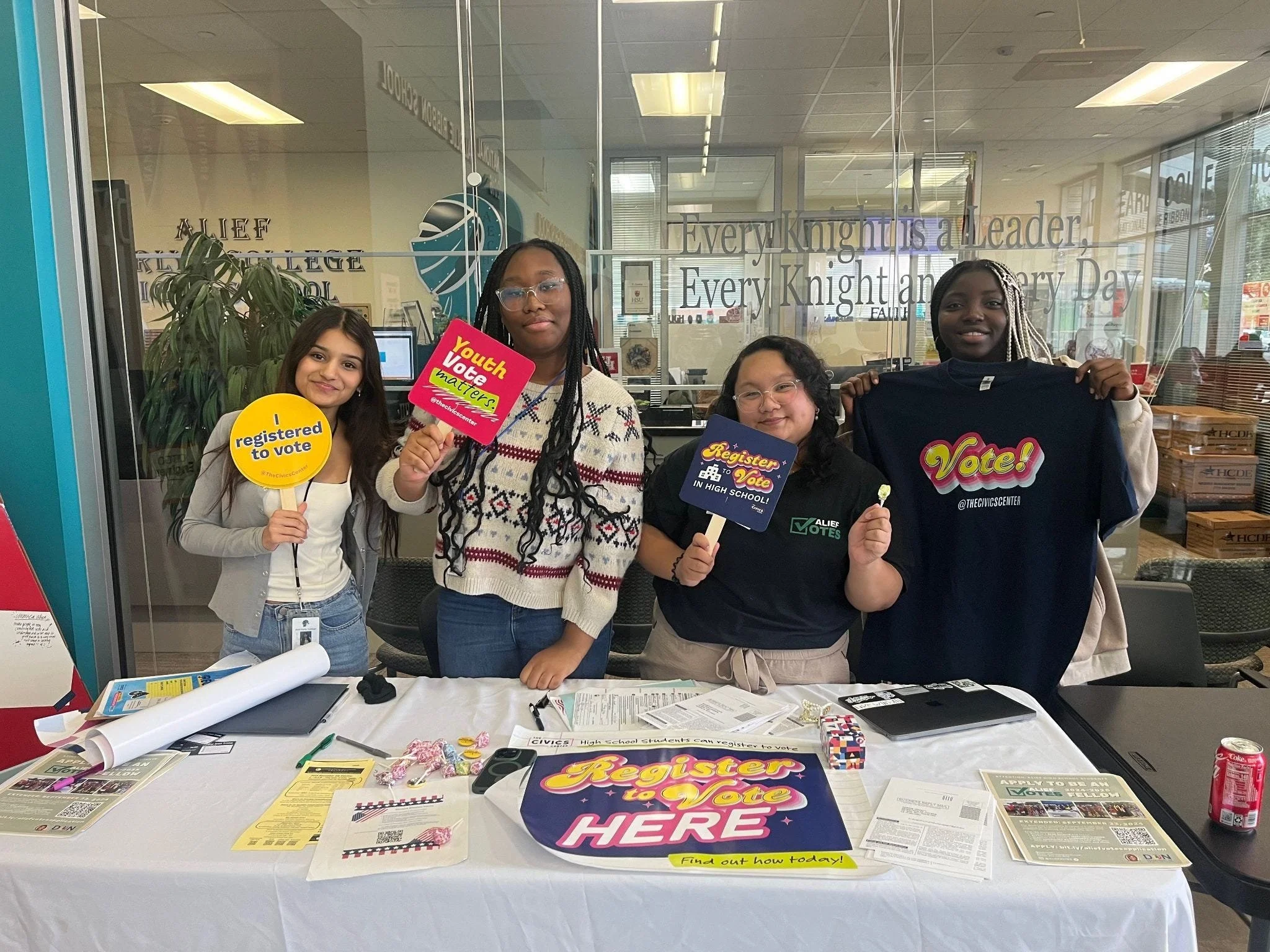
High school students and educators come to a training session to learn how to run a voter registration drive for their peers in school. We hold training sessions on zoom and also work with national and local partners so they’re tailored to the needs of each state.
After training, students and educators sign up with us to let us know they want to run a drive.
We send them swag – Democracy in a Box – full of energizing, actionable materials to help get them going.
They learn the ropes and organize within their schools. They learn how to work with their administration and how to improve over last time around. They dive into questions about how government at every level affects their lives, and how, whatever issues they care about, registering to vote and voting can send a message to elected officials.
We provide high schools with data to see how many 18-year-olds in their county remain unregistered, a dedicated registration portal for their school, and a leaderboard so high school communities can see their registration rates go up as they work to engage their communities.
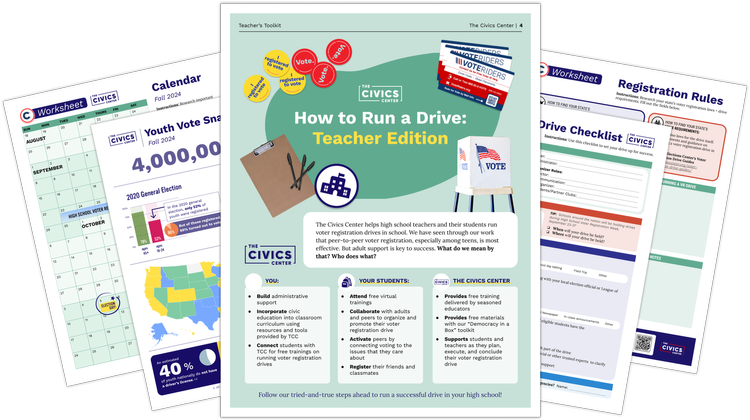
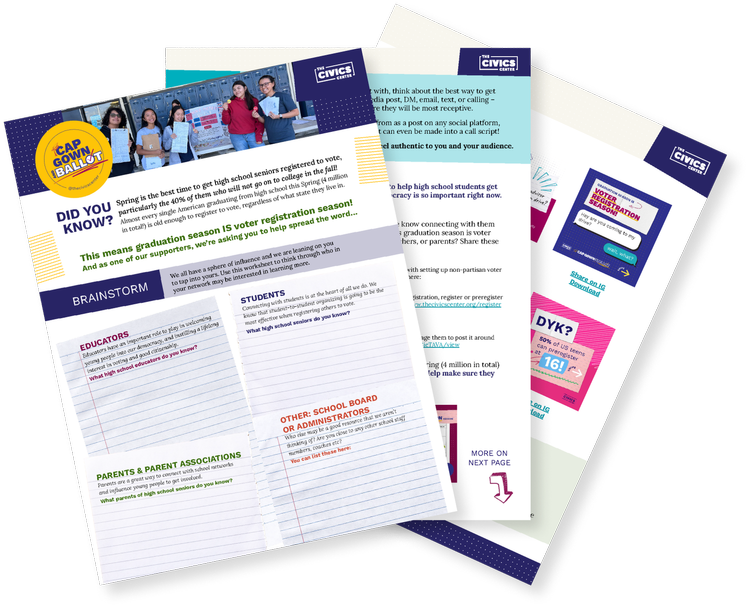
We have toolkits for educators to guide them through the process of supporting their students, and sustaining the program so it continues even after Seniors graduate.
We provide customizable graphics to post around school or to post on their social media or in group texts with their friends, letting students know about their opportunity to register in school, with the help of peers and trusted adults.
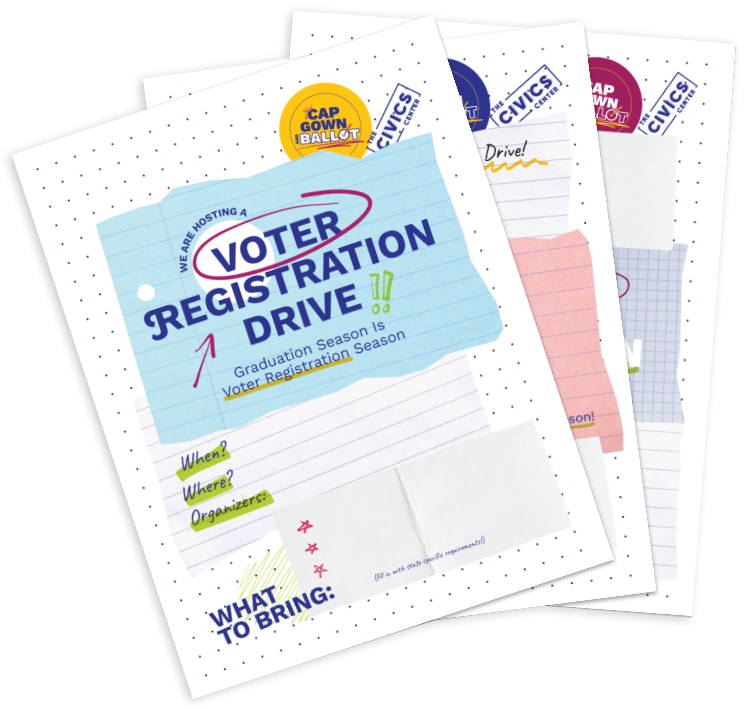
The high school communities do the work themselves. They own it.
The students make connections. They combat cynicism and loneliness. They develop as leaders and send a message that they believe in democracy and will be voting this year and for the rest of their lives. By their example, they show their whole community that voter registration should be part of high school life, all across the country, fall and spring, twice each year, every year, aligned with the school calendar, the election calendar, and their own coming of age. It’s civics education at its best because it’s hands-on knowledge, skills, dispositions, and relational organizing all at the same time. Life skills they will carry with them well beyond high school.
The basic policy support already exists. Young people have a right to vote starting at age 18, and most can register or preregister before they turn 18. More than half of US states and the District of Columbia have statutes expressly requiring high schools to help their students register. Almost all Seniors are old enough to register to vote before they graduate from high school. And students have the right to organize and communicate in their high schools, including about the right to vote.
Why isn’t it happening already?
The challenges are:
Awareness – most Americans, even many experts, remain unaware of laws allowing for preregistration in all 50 states or requiring high schools to help.
Implementation – doing something for the first time is hard, and that’s why we’re here to support. Once students and teachers take the reins, it’s easy!
Resources – training, boxes, gift cards…they’re all part of the plan but they cost money! If you have heard of the All by April campaign – a philanthropic campaign to invest in democracy early in the year – this is one of the best investments we know to strengthen democracy right now.
The support of our community makes all the difference.
Please share this post with educators and teens or with three friends who are connected with educators or teens. You can use our volunteer toolkit with shareable graphics and model communications to encourage everyone in your network to participate.
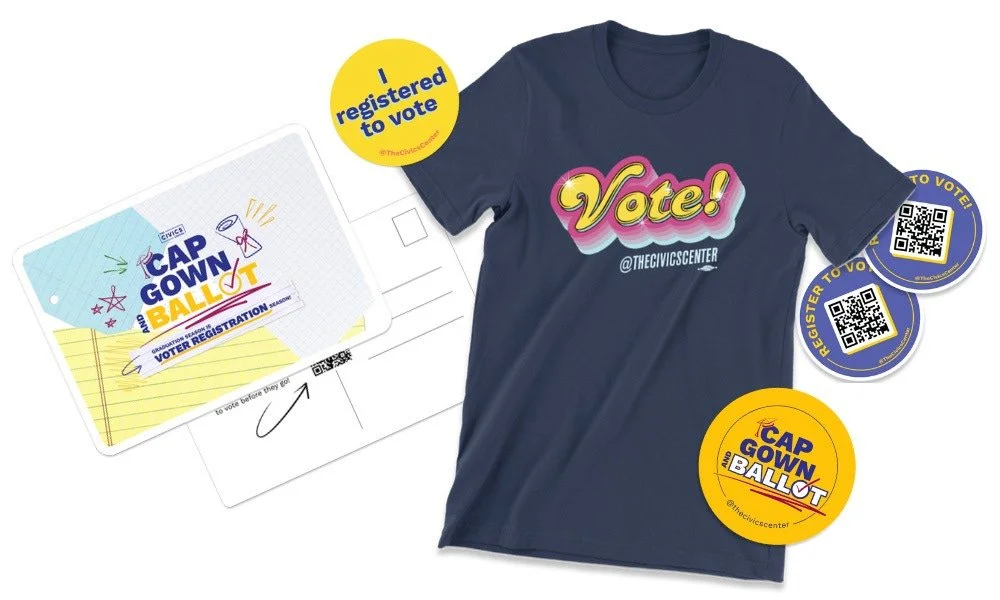
You can also buy our merch and share it with the high school community in your area. (Please note: The Civics Center does not receive any funds from these sales.)
A Democracy in a Box swag costs $100.
Providing resources like training sessions, educator toolkits, and the data and analysis to track progress over time require higher levels of investment and are just as critical.
In 2024, 52 schools had signed up to hold drives by this time of year. Right now, in 2026, we’re already at 86. While most voting programs shrink from a presidential year to the midterms, we are 65% higher! We are on track for the schools we support to reach more than 600 drives during this 2-year cycle.
4 million 18-year-olds are graduating this spring, and another 4 million next year. All across the country, people will be going to the polls in November 2026, and then again in state and local elections through 2027 and again in the next presidential election in 2028. We need your help to reach up-and-coming voters now.
One of the best ways to strengthen democracy, limit backsliding, and to promote free and fair elections now and in the future is to ensure that young people, regardless of what issues they care about, are not only registered but aware that they have power and their voices are critical.
Graduation season starts in just over one month.
The need is real.
The time is now.
Please join us.