New Voter Registration Resources for Educators Ahead of the 2026 Midterms
Lesson plans and a state-by-state guide to laws and policies to improve high school voter registration ahead of the midterms this fall, and for every election in your students’ futures
Now that teens are back in school, we're launching resources in preparation for our fall campaign, High School Voter Registration Weeks, now in its eighth year. 20% of high school seniors will be old enough to vote in the midterms in November, and more than 4 million high school students are old enough to preregister right now. That means they will come onto the voter rolls and be ready to vote as soon as they turn 18.
With voter registration deadlines approaching, I’m thrilled to share our latest offering to help build effective high school voter registration programs: a guide to what your state says schools should do to help students participate in our democracy.
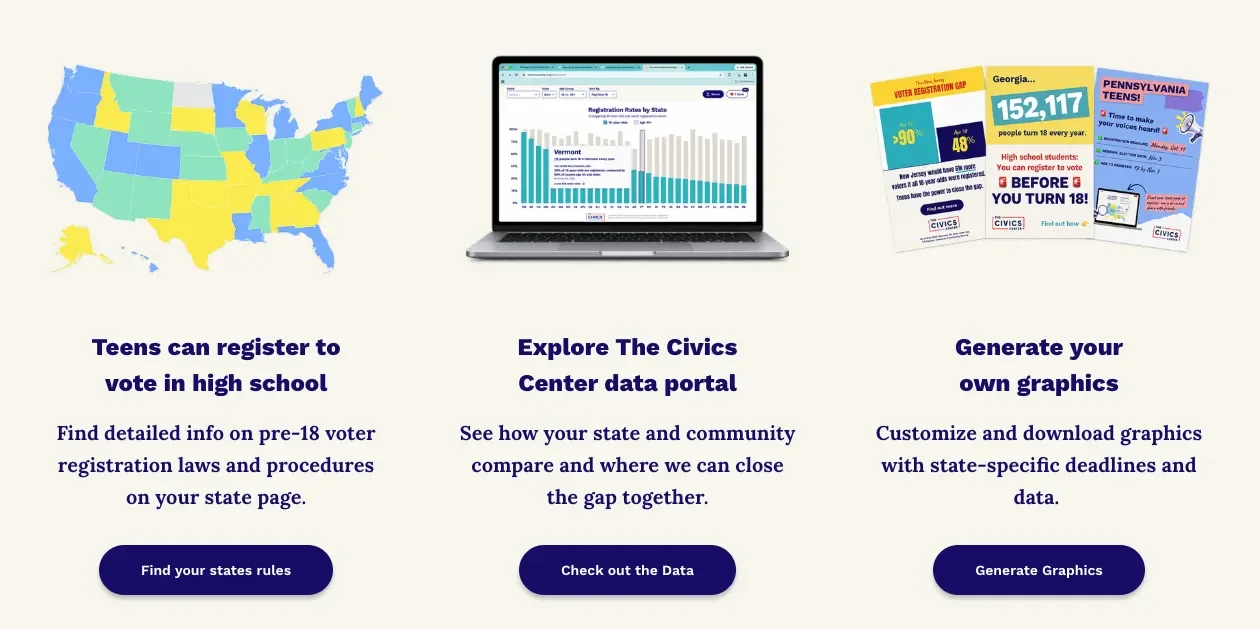
This guide is part of our new Educator Resource Bundle, containing lesson plans, state- and county-level data, and customizable graphics. Students analyze the impact that various policies and practices have on youth voter registration rates in their state, then develop actionable steps for their schools and states to take to ensure all eligible young voters are ready to participate in our democracy.
I am often asked, given the polarized times, whether we face pushback in our efforts to make voter registration part of high school life. The answer is we’ve faced very little push-back, and I attribute this to the fact that we develop cooperative relationships with school administrators, teachers, and parents, all of our resources are nonpartisan, and also, we are still very small.
On the other hand, there is no denying that many educators are fearful. They know they are doing the right thing in teaching their students about how democracy works and how they can have a voice, including the mechanics of getting registered. But they fear being attacked and vilified by those who would say that giving life to the civic mission of schools represents a partisan agenda.
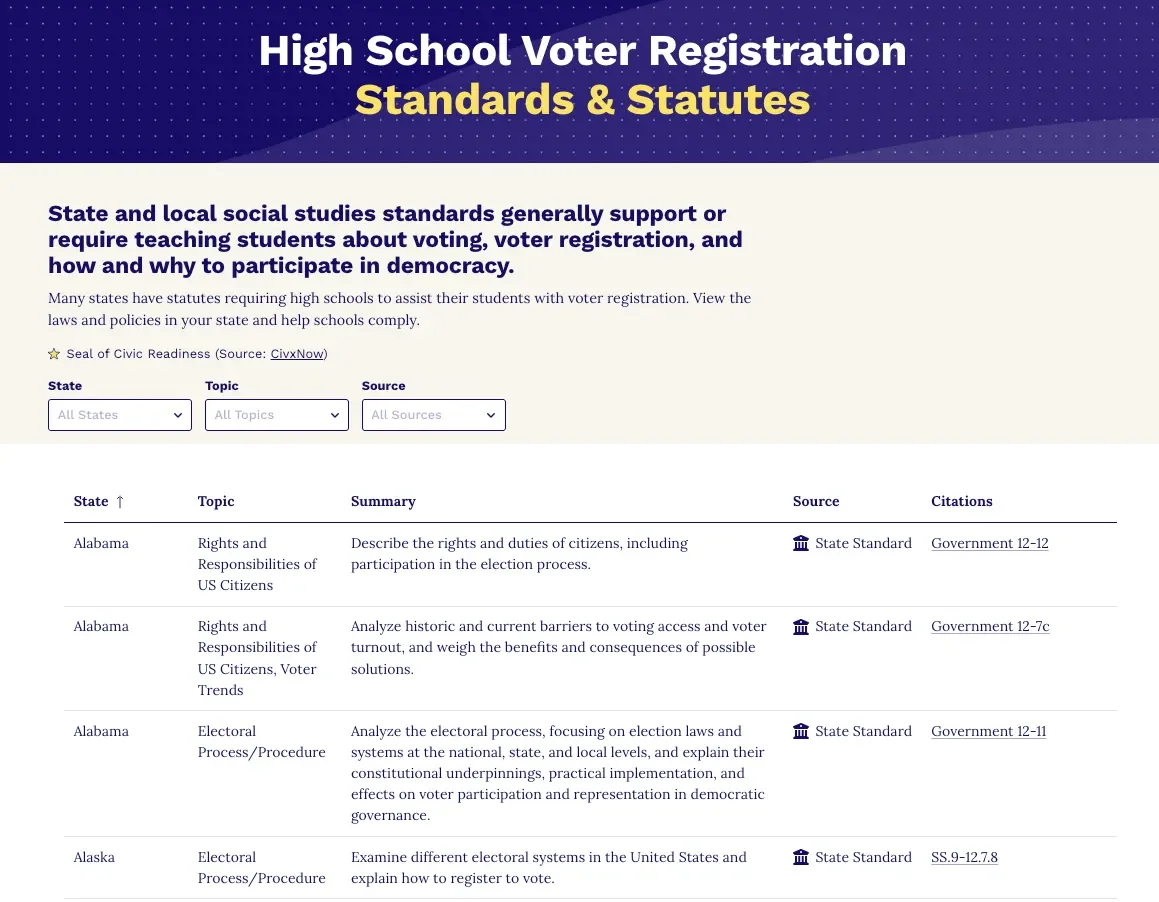
We are publishing these resources to show that this is not the case. Statutes exist in many states that require high schools to assist with voter registration. State social studies standards that guide teachers in what to cover in the classroom also support teaching about democracy, elections, voter registration, and voting.
Learning about such topics, and the ability of teens to participate as they come of age is and should be an essential part of high school. Teachers can bring these points to life for their students in ways that honor their students’ autonomy, agency, and decisionmaking. Seeing the breadth of policy support for this basic point, helps to create the conditions for schools to act accordingly.
States generally require (or at least support) teaching students about voting, voter registration, why our democracy matters and how to get involved – but those standards and laws vary dramatically, as I learned when I started doing this work.
In the decade following the notorious 2013 Shelby County vs Holder decision, in which the Supreme Court invalidated part of the Voting Rights Act, states enacted nearly 100 voter suppression laws. My former boss/mentor, Justice Ruth Bader Ginsburg, famously dissented; as she pointed out, ending protections against discrimination in elections was “like throwing away your umbrella in a rainstorm because you are not getting wet.”
What I took from Justice Ginsburg’s dissent was, if the courts will not uphold our democracy, it’s up to us – We the People – and that’s part of what inspired me to found The Civics Center. As I explored why so many teens were not voting, I learned about policy tools that are supposed to help the youngest voters. And I also learned that, unfortunately, most of them were unknown, under-funded, under-implemented.
We started digging up the data, investigating why youth voter registration rates vary so dramatically across states. And at the same time, we have been researching local laws and policies. It turns out that while many states have statutes requiring schools to help students register to vote, most don’t implement them – in part because so few people know the statutes even exist!
Now we have compiled a one-stop-shop listing so that educators, students, parents and policy makers can appreciate that voter registration is already part of high school life and an appropriate part of the civic mission of schools, at least as far as state standards are concerned. It is up to schools to develop and implement practices to catch up. Our list includes all statutory requirements for high school voter registration as well as social studies standards from every state that encourage teaching about voter registration as part of the regular high school curriculum.
We hope that all school communities will review their states’ approaches and model for their students quality of excellence in civic engagement that will bring these laws to life for all students.
Please share these resources with anyone you know in education so we can have the greatest possible impact together.
Charlotte Nichols, our Manager of Educator Development, and Bre Glover, our Democracy Fellow, wrote the lesson plans. Charlotte, Marissa O’Gara, Max Kessler, and I contributed to the research that underlies this resource, and Lisa Cohen, Clare Smythe and Andrew Branch are responsible for the visual presentation and ease of use.
If you appreciate the value of these resources, please consider a donation to The Civics Center. We do not have any special grant that supports this work. We are eager to do more to respond to the urgent requests we hear from educators about their needs.
With your support, we can continue to grow our resources and help students connect with their community and become full participants in democracy once and for all.