
Big State Challenge: The 5 Most Populous Are Failing Their Youngest Voters
With a race to the top, these states could turn things around, helping ensure free and fair elections in 2026 and beyond.
What do California, Texas, Florida, New York, Pennsylvania have in common? For starters, they are the five most populous US states. And, they are all missing opportunities to improve their futures, by failing to get their teens registered to vote as they come of age.
In every one of these states, fewer than half of 18-year-olds are registered. Combined, more than 1 million otherwise eligible 18-year-olds from these states are not yet ready to vote in the midterms, just under 4 months from now.
At the high end among these states, the registration rate for 18-year-old voters in Florida is 47%, which is twice as high as in Pennsylvania, with 22% of its 18-year-olds registered. New York manages 38%. And California at 43% is 10 points higher than Texas, with just 33% of its 18-year-olds registered.
All of these rates are at least 30 percentage points lower than the rates for voters ages 45 and above, and in Pennsylvania, registration rates for older voters tower over those of 18-year-olds by a full 60 percentage points.
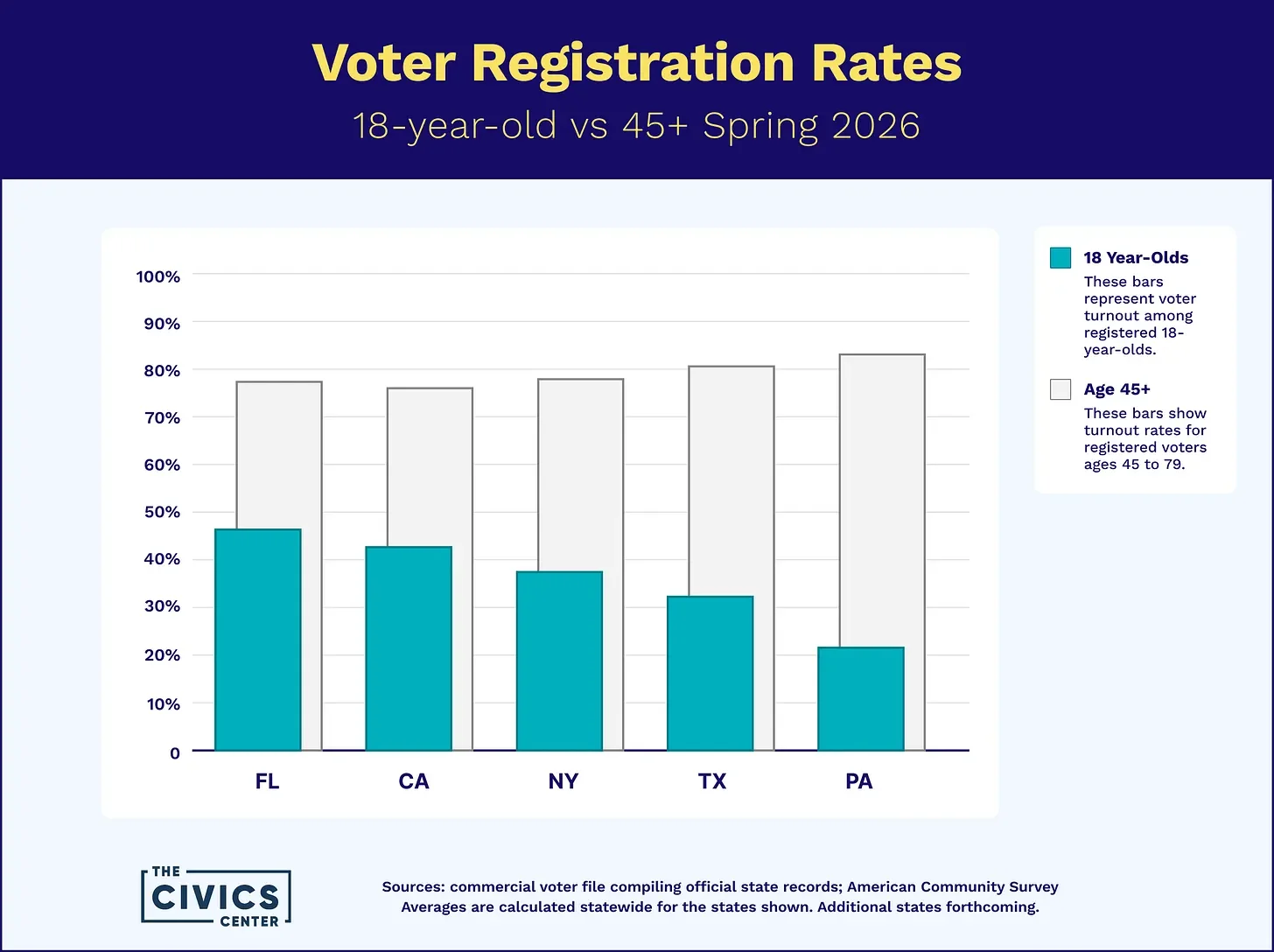
However we look at these numbers, the main takeaway is that if voter registration were graded like a high school test, scoring under 50% is not a passing grade, and every one of these states would fail. And the people losing out are their own children, just as they are coming of age.
These states have so much pride and clout, so why can’t they get such a basic job done? Why do these big states trail so far behind Oregon, Michigan, and Colorado, all of which have managed to get 70% or more of their 18-year-olds registered?
The problem is not young people. It’s a problem of systems and implementation and building a cultural tradition in which students are at the center and registration is the norm.
Registration rates typically peak around election time. But in 2022, even with that bump, only Texas broke 50%, winding up at 52% of 18-year-olds registered at election time, while Pennsylvania did not crack 30%.
It’s a more hopeful picture looking at the change since this time four years ago and observing the gains and losses since Spring 2022. There New York wins the prize for most improved, with a 12-point gain since 2022, perhaps because, New York, which enacted preregistration starting at age 16 back in 2020, has since made online voter registration easier and enacted state law for school boards to have policies to make sure it gets done.
New York’s gain is followed by Florida with a 9 point gain and Pennsylvania up 6. Meanwhile in California, where Gov. Gavin Newsom has three times vetoed legislation that would have helped the youngest voters register, we see just a 2 point gain. Texas loses big, with a 10-point decline in registered 18-year-olds since 2022. What’s up Texas? Don’t you love your kids?
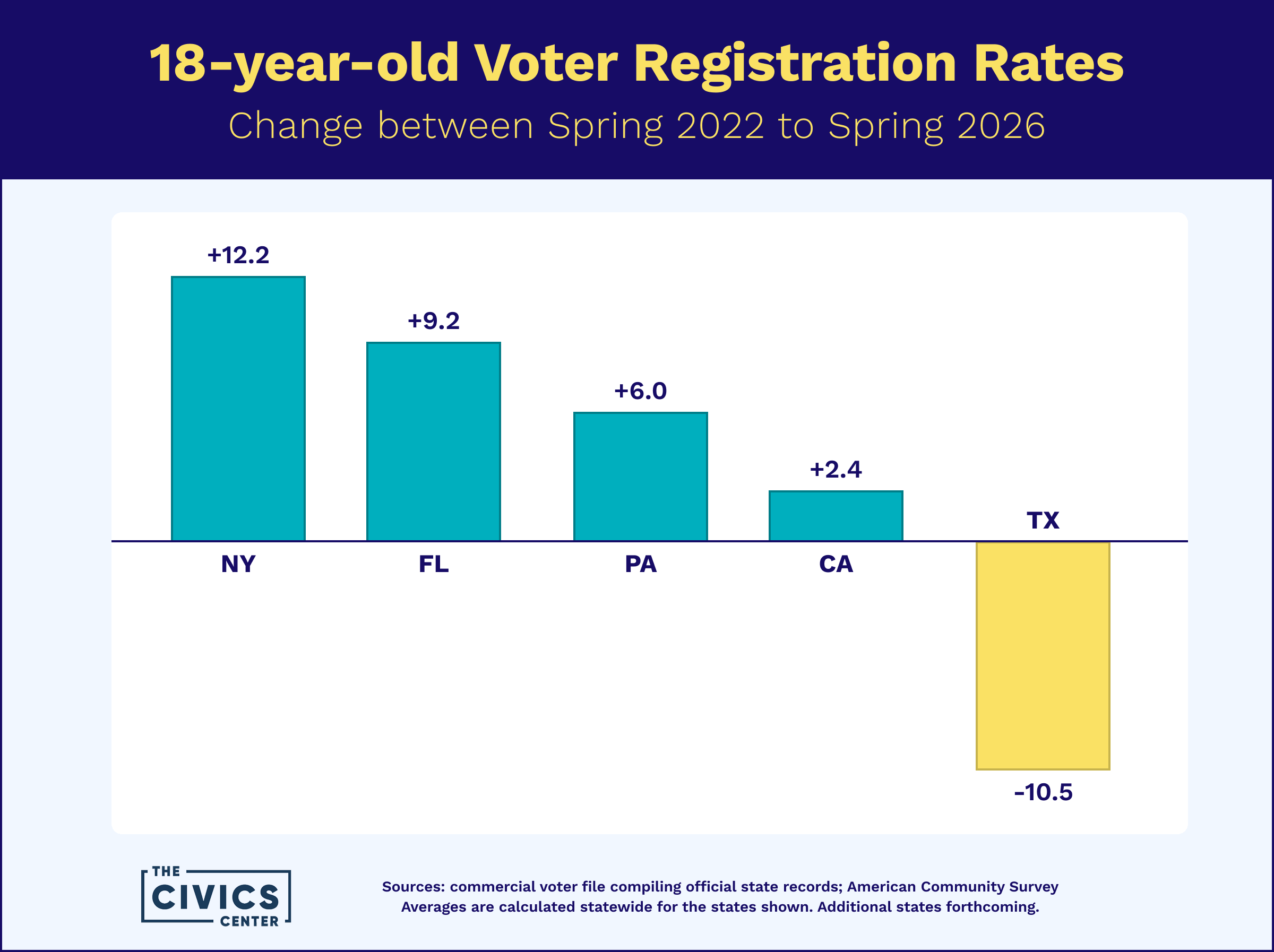
Even factoring in Texas’s dramatic decline, it’s an average of a 4 point gain in just 4 years across these five states. Excluding Texas, it’s an average gain of more than 7 points for the other four states in the same period. So as low as the overall rates are today, one big takeaway is that dramatic changes are possible, and that’s a reason for hope.
The thing now is for big states to increase the upward momentum and to do so in a big way. That calls for a Big State Challenge, to encourage these trendsetting states to get their acts together, get their teens registered, and set a positive example.
Because to do all we can to make free and fair elections in the US more likely, we need high turnout. High turnout means high levels of engagement and a belief that democracy is working. Low turnout tends to foster distrust in elections. And either way, in this country, turnout starts with registration, but registration is often overlooked or thought of as taking care of itself. Obviously, that’s not happening, or registration rates for 18-year-olds in the most-populous states in America would not be so low.
Other than their size and willingness to allow the political participation of their youngest voters to wither on the vine, these states do not have much in common. They have different political, cultural, and geographic orientations and varied voter registration policies. In California, Florida, and New York teens can preregister to vote at 16, but Texas and Pennsylvania have much narrower windows. In Texas, you have to be 17 years and 10 months old in order to register, and in Pennsylvania, you can register if you will be 18 by the next election, but if you turn 18 after the primary and before the general election, you have to wait until the primary has passed before you can register.
But regardless of where they are starting, the game is not over – in fact, it’s only just beginning. If you believe, as we do, that it’s fundamentally unfair for so many 18-year-olds in these states, and those coming of age ahead of the 2028 presidential election, to remain unregistered, then there is a simple solution. Help them register. That means a race to the top, instead of the bottom. And everyone can participate.
So if you live in California, Texas, Florida, New York, or Pennsylvania, help us get the message to Gavin, Greg, Ron, Kathy, and Josh that they need to lend a hand, and if they need some help, they can call Big Gretch in Michigan, who is putting them all to shame.
While you’re at it, tell the Knicks and the Spurs. They know something about competition. And with baseball season here, tell the Dodgers, the Marlins and the Phillies, as well.
And don’t forget the people who matter most. The teens, parents, and educators in your life that your state needs to gear up to win this challenge!
Here’s how:
Make sure your community knows that teens can register before they turn 18. Make sure everyone knows the deadlines and what they need. Start with our resources pages for California, Texas, Florida, New York, and Pennsylvania, and share this information widely, because knowledge is power.
Tell your kids, your friends, your elected officials, your local school faculty, your community organizations, sports teams and favorite ice cream shop.
Then encourage students, educators and parents to explore helpful resources, like our step-by-step guide to setting up high school registration drives. Or Vote411 from our partners at the League of Women Voters and Protect Democracy’s Gen Z toolkit.
We promise to update our numbers every time we get new data on how many of the youngest voters are registered. We will keep partnering with local community organizations to make the registration process as easy as possible.
Whether your state wins this race or not, we should all be able to say, with confidence, that we’ve each played our part to get as many young Americans as possible ready for the ballot box.