
The Youth Voting Rights Act Aims to Open Voting Access To The Youngest Voters. Here’s Why You Should Support It.
I’m excited that Senator Elizabeth Warren and Representative Nikema Williams have introduced the Youth Voting Rights Act, which would address our national failure to effectively implement the 26th Amendment. Since that amendment passed in 1971, establishing the right of 18-year-olds to vote, Congress has done little to effectively enforce that right and in practice, most of the youngest eligible Americans are not registered to vote.
This bill, which is endorsed by The Civics Center and dozens of other pro-democracy and youth organizations, would protect youth voting rights, including by requiring every state to allow preregistration from age 16. Every American should be registered to vote before they graduate from high school and pre-registration is key to that: if 16- and 17-year-olds can sign up – especially in a school setting where trusted adults and peers can teach them not just how to participate in our democracy but why that matters - they will be ready to vote as soon as they come of age.
At The Civics Center, we’ve created an online email campaign so that you can write to your representatives and urge Congress to pass the Youth Voting Rights Act. We urge you to sign, even if you believe that the law has little to no chance of passing in the current Congress. It’s important that your elected officials know that you support the right to vote, including for the youngest voters.
If you care about free and fair elections and you believe everyone eligible should be included as soon as they come of age, let your representatives know that the YVRA is part of a solid foundation for our democracy.
There are so many ways in addition to preregistration in which the YVRA would effectively welcome younger voters into our democracy.
It would expand voting access by designating public colleges and universities as “voter registration agencies” under the National Voter Registration Act of 1993, which would oblige these institutions, alongside state DMVs, to help with registration.
As it happens, high schools are already included in the 1993 Act as agencies that states may designate as official voter registration agencies. And some states have designated them as such. Unfortunately, many existing laws and statutes authorizing schools to promote voter registration are unknown, ignored or unfunded – a new focus on youth voting would also encourage implementation of existing laws.
If passed, the bill would require states to accept college student IDs to meet state voter identification requirements in federal elections, which would help the millions of young Americans who don’t hold drivers licenses, passports or other state ID cards. And it would increase voter registration opportunities at universities and create a grant program for youth participation in elections.
Also dear to my heart, given our focus on gathering and analyzing data to understand and improve youth voting, the bill requires the federal government to study and report on youth voter trends.
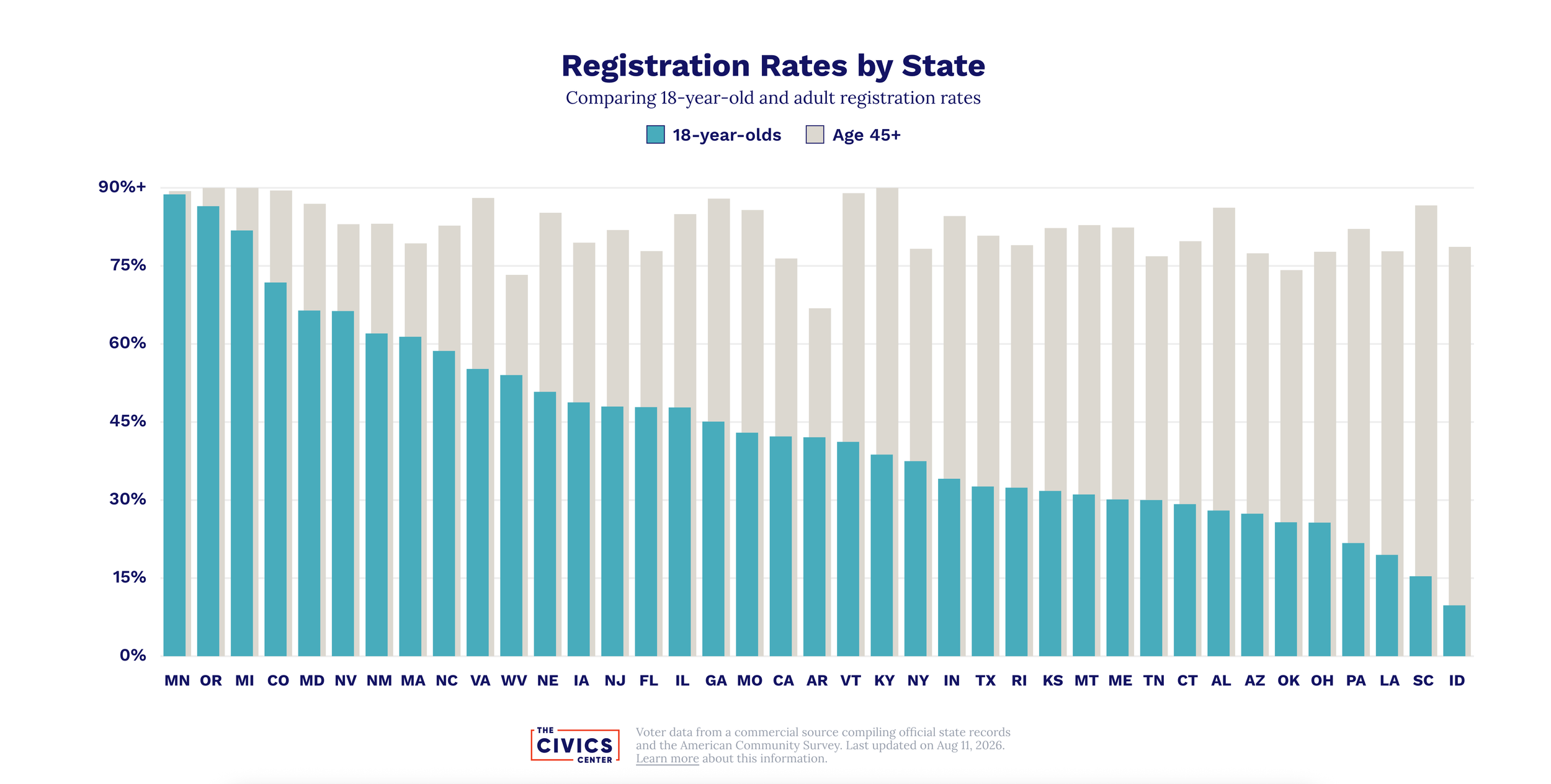
Real numbers help us understand the world around us, including the obstacles that prevent more teens from registering and turning out. For example, despite the conventional wisdom that they just don’t care, young Americans who are registered to vote turn out at similar rates to older compatriots in big elections. The main problem is that fewer than half of 18-year-olds are registered to vote, compared to 82% of the over-45s. To give you a few raw numbers: some 4 million Americans turn 18 every year, and nationwide, only 45% of them are registered to vote. That’s actually an improvement on this point in 2022, when only 37% had registered. By the time of the 2022 midterms, 18-year-olds were up to 44%. If we see a similar spike this time, that will put the registration rate for 18-year-olds above 50%, a huge increase in only four years.
If the YVRA passes, the registration rate for 18-year-olds is likely to go even higher, since nationwide, they will have at least two full years before a first election in which to register to vote.
Today, we’re seeing states like MN, OR, MI & CO exceed the 70% threshold when they adopt and implement systems built with the needs of young people in mind. They’ve already proved we can effectively implement the 26th Amendment – all it takes is political will. With the YVRA, we could make it happen now across our country.